-1.svg)
From Offshore Platforms to Paddle Craft
August 11, 2026
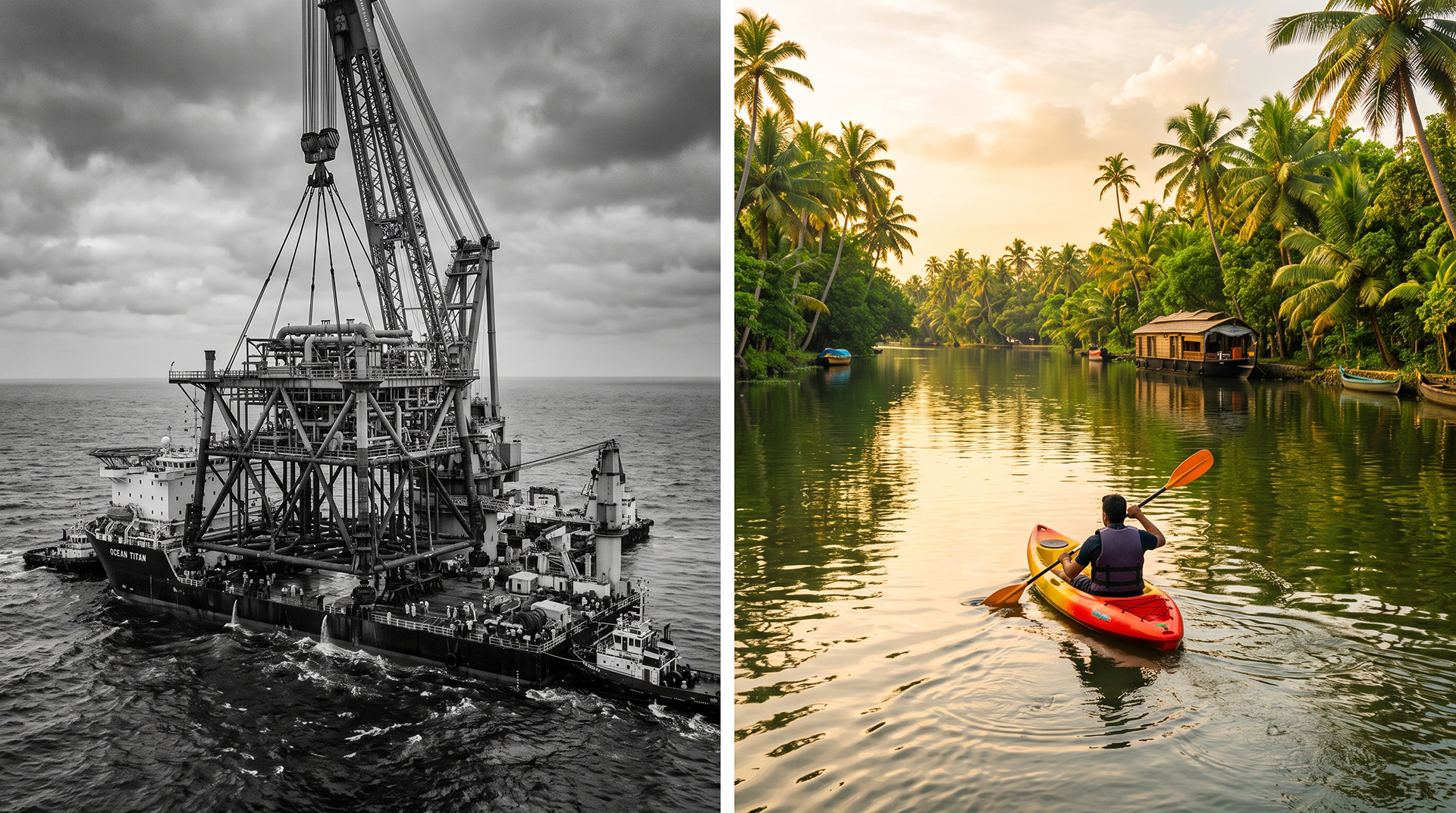
The story behind MKEL — and why a company that engineers structures for the world’s toughest offshore projects decided to build kayaks.
ARTICLE
There’s a question I get asked often, sometimes politely and sometimes with a raised eyebrow: “You design structures for offshore platforms and heavy-lift vessels. Why are you making kayaks?”
It’s a fair question. So let me answer it properly.
The first fifteen years
I’m an engineer from Kochi. For most of my career, I’ve worked in a corner of the industry that most people never see: the engineering behind marine and offshore operations. When a thousand-tonne platform module needs to be transported across the North Sea, someone has to calculate how it’s fastened to the vessel’s deck. When a jack-up crane needs to be removed and relocated, someone has to verify that every load path, every weld, and every lifting point will hold. When an offshore wind installation vessel heads out to install monopiles in open water, the temporary structures on its deck — the seafastenings, the load spreaders, the tool stands — have all been designed, analysed, and approved before the ship leaves port.
That’s the work I built my career on. Over the years, the engineering practice I founded grew into a team of more than 75 engineers, designers, and naval architects working across India, the Netherlands, and the UAE — serving heavy-lift contractors, offshore wind installers, and marine operators across Europe and beyond.
It’s demanding work, and it has one defining characteristic: there is no room for “good enough.” Every design is verified against international standards. Every calculation is reviewed by classification societies — DNV, Lloyd’s Register, ABS, Bureau Veritas, IRS, RINA. Every structure has to perform in the most unforgiving environment on Earth: the open sea.
You don’t survive in that industry by cutting corners. You survive by building a culture where precision is the default — where every weld procedure, every material certificate, every safety factor is documented and defensible. That culture is the real asset. And a few years ago, I started asking myself: what else could it build?
The question that started MKEL
I grew up in Kerala, surrounded by water. Backwaters, rivers, the Arabian Sea — water is not scenery here; it’s the fabric of the place. And yet, whenever I looked at the world of marine leisure — the boats, the kayaks, the sailing craft that people in other water-rich countries take for granted — I saw almost nothing Indian.
France has Beneteau. Germany has Bavaria. Italy has Ferretti and Azimut. These aren’t just companies; they’re national statements — proof that their countries can design and build beautiful, desirable things for the water. India, with 7,500 kilometres of coastline and a maritime heritage older than most nations, has no equivalent. The premium end of our market is entirely imported. The domestic end is largely basic. And the idea of an Indian marine craft that someone in Europe or the Middle East might aspire to own — that idea barely exists.
I found that unacceptable. Not as a patriot making a slogan, but as an engineer looking at a gap: we have the waters, we have the talent, we have world-class manufacturing capability in this country. What we don’t have is a brand that puts them together and holds itself to a global standard. MKEL exists to be that brand.
Why start with a kayak?
Because a kayak is honest. A kayak has nowhere to hide. There’s no engine to mask a heavy hull, no electronics to distract from poor build quality. It’s a pure expression of hull design, materials, and craftsmanship. If the shape is wrong, you feel it in the first ten paddle strokes. If the laminate is poor, you feel it in the weight the moment you lift it.
So when we decided to build our first products, we treated the kayak the way we’d treat an offshore structure. The hull forms were developed by naval architects — the same discipline of hydrostatics, stability analysis, and resistance calculation that goes into vessels a hundred times the size. The laminate schedules were engineered, not guessed. And we chose to manufacture them the way high-performance marine and aerospace structures are made: vacuum-infused fibre reinforced polymer, producing laminates with over 55% fibre content — lighter, stiffer, and more consistent than anything hand layup can achieve. We simply refused to accept that a recreational craft deserves less.
The rigour transfers
Here’s what fifteen years of class-approved engineering actually gives a kayak buyer. Designed, not styled: every hull begins with functional requirements and naval architecture calculations. Engineered laminates: we know the safety margins because we designed them. Documented quality: every MKEL craft leaves our workshop with a build record — materials, production date, inspection results — a habit that comes straight from the offshore world, where documentation isn’t optional. And a workshop that builds both: the same group facilities in Kochi that produce certified steel structures for industrial clients produce our composite hulls. One quality culture, two materials.
Where this is going
The kayaks — our NavIQ range — are the beginning, not the destination. They are our proving ground: the products through which we perfect our composite production, build our team, and earn the right to be trusted with bigger things. Behind them, on our design boards right now: a 27-foot fishing tender. A 36-foot work boat. And, further out, a sailing catamaran — the kind of vessel that, until now, no one expected to carry the words Designed and built in India.
The sea doesn’t grade on a curve. It doesn’t care where a structure was designed or who built it. It only asks one question: was it done right? That’s the only question we ask at MKEL, too.
— Jose Babu Maliakel is the Founder and Managing Director of the MKEL Group, Kochi.
.jpeg)